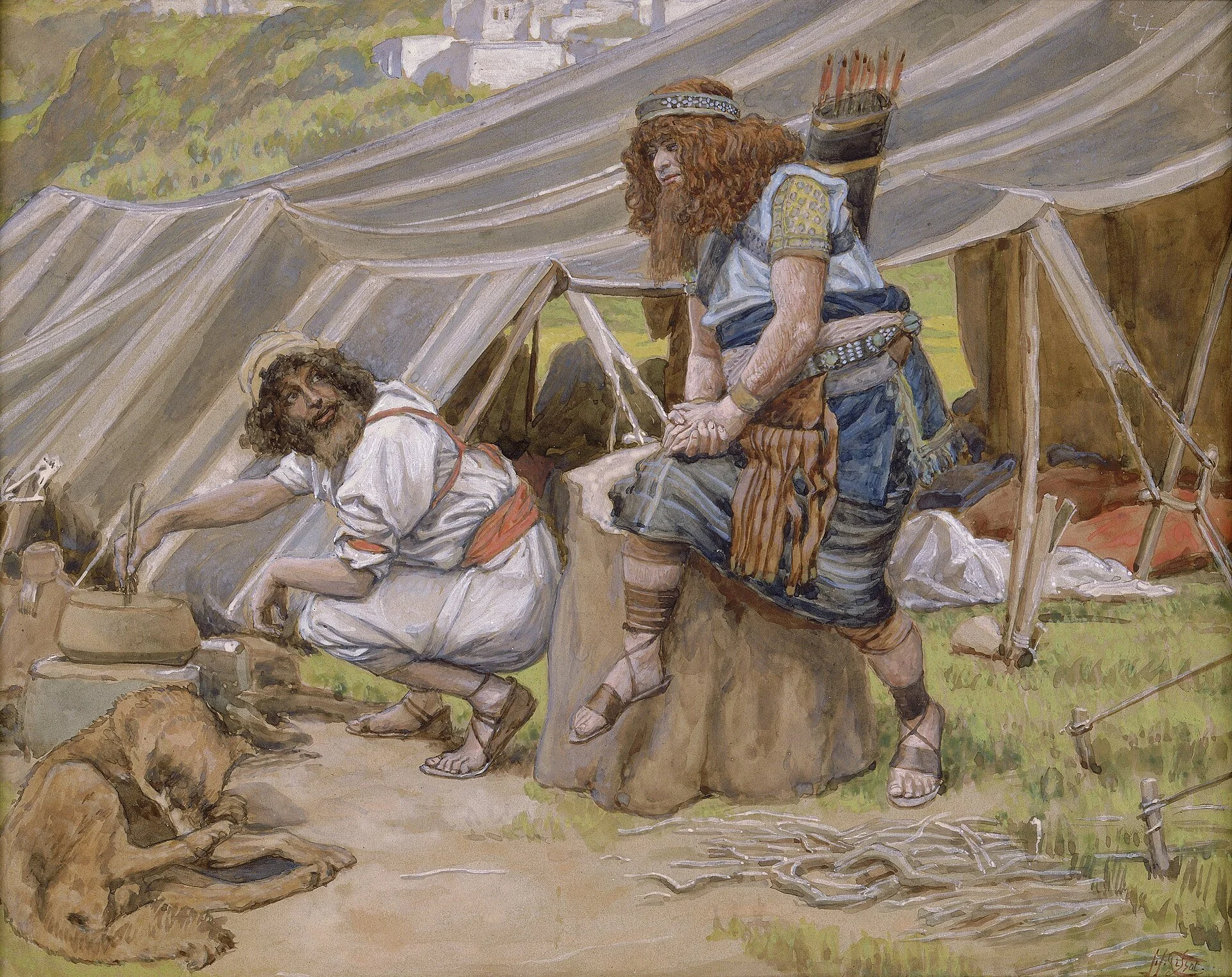
The Mess of Pottage (watercolor circa 1896–1902 by James Tissot)
“Once when Ya’akov was cooking stew, Esav came in from the field, and he was exhausted. And Esav said to Ya’akov, ‘Let me eat some of that red stew, for I am exhausted!’ Ya’akov said, ‘Sell me your birthright now.’ Esav said, ‘I am about to die; of what use is a birthright to me?’ Ya’akov said, ‘Swear to me now.’ So he swore to him and sold his birthright to Ya’akov. Then Ya’akov gave Esav bread and lentil stew, and he ate and drank and rose and went his way. Thus Esav despised his birthright.”
The Torah tells us that Esav came in from the field exhausted and hungry. All he wants is something to eat. But when Ya’akov demands his birthright in exchange for a bowl of stew, Esav agrees. Esav exchanged something of great value—the birthright of the firstborn—for something that would satisfy him only temporarily. Notice how the Torah describes his lack of concern: “Ya’akov gave Esav bread and lentil stew, and he ate and drank and rose and went his way.”
Sure he felt famished, but if he truly valued and cherished his father’s inheritance, would he have still sold it so casually?
The writer of the Epistle to the Hebrews warns us not to be “a profane person like Esav, who for one morsel of food sold his birthright” (Hebrews 12:16). A profane person is one whose mind is focused on the secular and carnal—the temporal world. He treats the sacred and divine as if it has little value. He lives for now, for this age, and the things of this world. He did not appreciate the monumental value of his birthright until it was too late, as the writer of Hebrews goes on to describe:
“For you know that even afterward, when he wanted to inherit the blessing, he was rejected, for he found no place for repentance, though he sought for it with tears.”
—Hebrews 12:17
How sad and terrible. Esav cried and wailed, but he did not repent of his profane mind. He regretted what he did. He felt bad for what he did, but he did not repent. He did not admit to his wrongdoing and ask for forgiveness—he did not change as a result of his regret. What did he do instead?
The Torah says “Esav harbored a grudge against Ya’akov” and was “consoling himself by planning to kill [him]” (Genesis 27:41–42). Whatever we understand about his anger, this attitude is exactly the opposite response of a penitent individual who recognized their mistake and wished to make things right.
What about us? How do we treat the priceless inheritance that HaShem has promised us? What do our everyday choices reveal about what we truly value? When we choose to satisfy sinful desires and fleeting passions rather than obey HaShem, are we not despising our inheritance, as Esav?
What is this inheritance? The author of Hebrews explains just a few verses later:
“But you have come to Mount Zion and to the city of the living God, the heavenly Jerusalem, and to myriads of angels, to the general assembly and [assembly] of the firstborn who are enrolled in heaven, and to God, the Judge of all, and to the spirits of the righteous made perfect, and to [Yeshua], the mediator of a new covenant, and to the sprinkled blood…”
—Hebrews 12:22–24
Through our Master Yeshua the Messiah, the Son of God, we have been granted access to HaShem, belonging among His people Israel, resurrection of the dead, and a share in the world to come. The beauty of this inheritance reveals just how deeply we are loved. Elder Ephraim, an Orthodox monk and spiritual father from Mount Athos, reflects on this in his book Counsels from the Holy Mountain:
A time will come, the hour will strike, the moment will arrive for these eyes to close and for the soul’s eyes to open. Then we shall see a new world, new beings, a new creation, a new life without end…
Who is able to express in words or with a pen the joy, the exaltation, the bliss of those blessed saved souls? Blessed are they who have died in the Lord, for the riches of God’s goodness awaits them…
Before the Passion, the Lord entreated His heavenly Father on behalf of His disciples and those who would believe through them: “Father, I desire that they also whom Thou hast given Me may be with Me where I am, that they may behold My glory which Thou hast given Me; for Thou didst love Me before the foundation of the world.” (Jn. 17:24).
How great is Jesus’ love for us! He took on human nature and was hanged upon the Cross, giving us freedom and paying off our debt to His heavenly Father. And as a dear brother, He makes us worthy of jointly inheriting the infinite wealth of His heavenly Father! Oh, what love for us!
—Elder Ephraim, Counsels from the Holy Mountain, “On Salvation and Paradise,” §2, abridged.
Esav’s example warns us against living for the temporary things of this world. It calls us to forsake sinful desires, take up our cross, and follow our Master. “United with Him in the likeness of His death” (Romans 6:5), we believe that “we shall also live with him” (Romans 6:8). “So you too,” our apostle Sha’ul exhorts us, “consider yourselves to be dead to sin, but alive to God in Messiah Yeshua” (Romans 6:11).
How do we learn to live this way? Consider the contrast the Torah draws between the brothers as they grew: Esav became “a man of the field,” while Ya’akov was “a simple man, abiding in tents” (Genesis 25:27). Rashi, drawing on the Midrash, understands these as the houses of study of Shem, the son of Noach, and his great-grandson Ever, who, according to Jewish tradition, preserved and passed down knowledge of HaShem and His commandments. Both brothers came from the same household, yet the Torah describes they took different paths. In this traditional reading, Ya’akov’s tents draw our attention to the place sacred learning held in his life.
This reminds us how important it is to raise our children in the admonition of the LORD—to set them on the right path so that when they go out into the world, they are better equipped. But it also reminds us of the importance of Torah study in our own daily lives. We must make room to study God’s Word, to abide in the teachings of our Master Yeshua: to consider God’s goodness and severity, to remember His promises, and to allow His words to examine the desires of our hearts.
When the passions stir within us—when anger rises, or resentment takes hold, or a sinful pleasure draws us—we must watch over our hearts, remember His words, and turn to God in prayer, asking for His grace to overcome. Through these small, daily struggles, our love for Him deepens, and obedience becomes that much sweeter.
Let us keep this hope always before us: to sit at the table with Avraham, Yitzhak, and Ya’akov in the kingdom of heaven (Matthew 8:11); to “behold the beauty of the LORD” and dwell in His presence (Psalm 27:4); to stand among the redeemed, where God Himself will wipe away every tear and death and sorrow will be no more (Revelation 21:3–4). This is the future our Master has opened to us through His love: “and so shall we ever be with the Lord” (1 Thessalonians 4:17). May we recognize and cherish that promise enough to let it shape the choices we make today.
Father in heaven, thank You for the priceless inheritance You have promised us through Your Son, Messiah Yeshua. Forgive us for the times we have treated lightly what You have given at such great cost. Through Your Spirit, teach us to cherish Your promises and find joy in Your words. When our passions press upon us, help us to remember You and choose what is pleasing in Your sight. And if we fail, soften our hearts to return to You in true repentance. Keep before us the hope of Your kingdom, where we will behold Your goodness and dwell with You forever. May that hope shape how we live today. Amen.